CLICK HERE for the conference program and abstracts
CLICK HERE for Registration for Online Attendees (Closed on August 25)
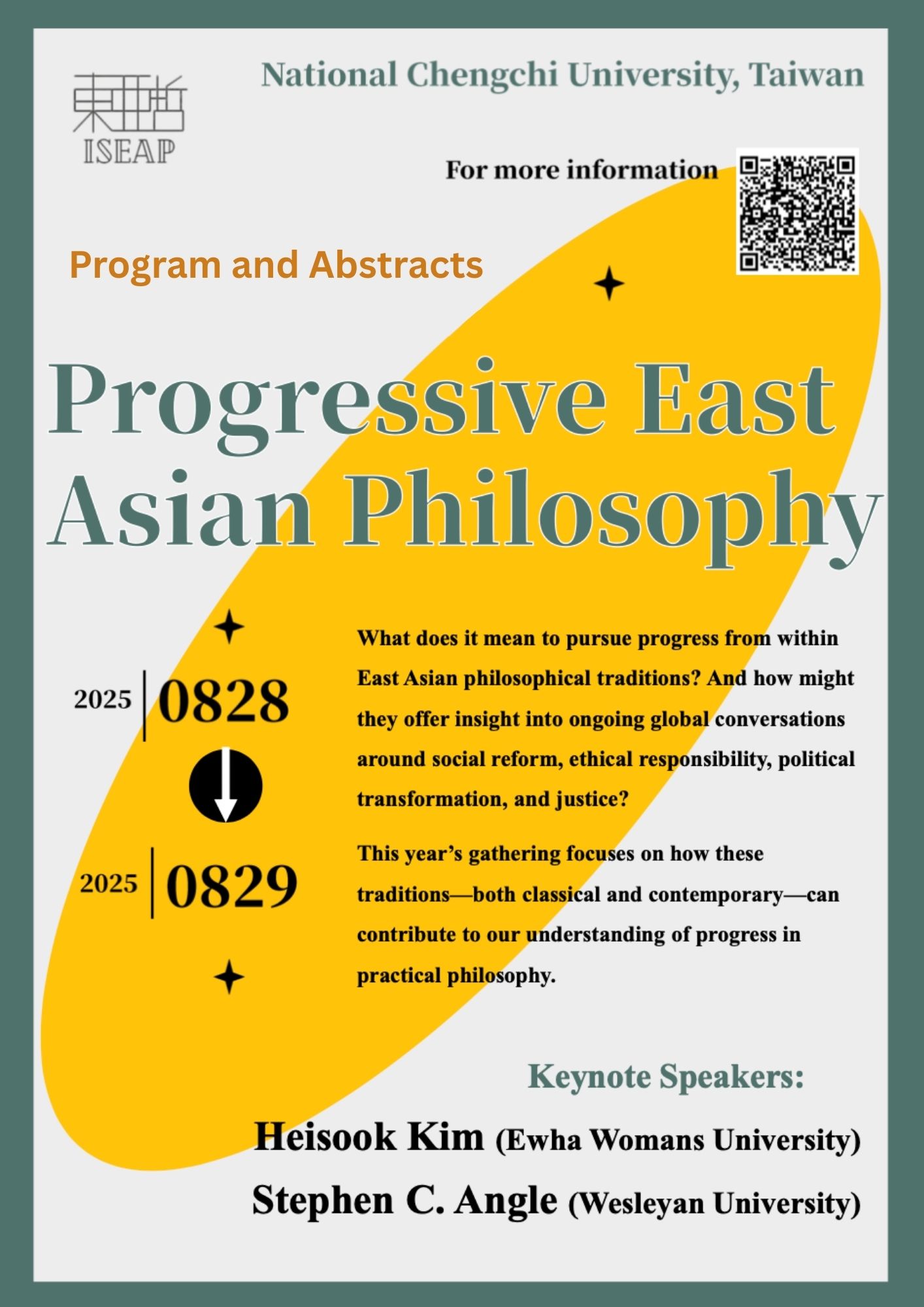
Date: August 28–29, 2025 (Thursday and Friday)
Venue: National Chengchi University, Taiwan
[In-person and Virtual]
Organizer: International Society of East Asian Philosophy (ISEAP), National Chengchi University, Taiwan
Languages
English (preferable), Japanese, Chinese and Korean
Publication
Presented papers will be invited to submit to a special issue of The Journal of East Asian Philosophy (published by Springer, peer-reviewed, all in English)
Keynote Speakers
Professor Heisook Kim
Ewha Womans University
Professor Stephen C. Angle
Wesleyan University
Important Dates
June 1, 2025 June 15, 2025 NEW!
Submission deadline for abstracts for organized panels and individual papers
Late June, 2025 Early July, 2025 NEW!
Notification of acceptance by email
Early August, 2025
Release of tentative program
Aug 28-29, 2025
ISEAP Conference 2025
Submission of proposals
Submission Deadline: June 15, 2025(Japan Time)
For individual papers:
1)Please download the application form HERE. (Please open the link, then go to “File”→”Download”→ “Microsoft Word” to download the application form.)
2)Please submit your application through the following google form.
https://forms.gle/3ecWC416pAWaL4Ad9
(Please submit a Word file only, named ‘Your Full Name_IP’.)
For organized panels(3-4 members):
1)Please download the application form HERE. (Please open the link, then go to “File”→”Download”→ “Microsoft Word” to download the application form.)
2)Please submit your application through the following google form.
https://forms.gle/KQwieMrjJKvLvfsL9
(Please submit a Word file only, named ‘Your Panel Title_OP’.)
Registration fee
Free of charge
Enquiry
Synopsis
The 2025 ISEAP Conference invites submissions on the theme “Progressive East Asian Philosophy.” This year’s gathering focuses on how East Asian philosophical traditions—both classical and contemporary—can contribute to our understanding of progress in practical philosophy. What does it mean to pursue progress from within these traditions? And how might they offer insight into ongoing global conversations around social reform, ethical responsibility, political transformation, and justice?
This theme takes inspiration from Progressive Confucianism, a contemporary philosophical movement that emphasizes moral development at both the individual and societal levels while directly engaging with the challenges of the modern world. As articulated by Stephen C. Angle, Progressive Confucianism reinterprets classical ideas to address issues such as political authority, the rule of law, human rights, gender equality, and social justice. It draws on the legacy of Contemporary New Confucianism, which has also influenced the emerging field of Contemporary New Daoism. Much like the Kyoto School in Japan, these intellectual developments explore how traditional philosophical resources can speak meaningfully to modern interpretive contexts: How can they participate in contemporary discourse? How can they respond to the challenges of modernity and address the issues of our time? And how can they generate new interpretive momentum for rearticulating classical ideas in present-day terms?
Building on these models, the conference seeks to broaden the conversation beyond Confucianism to engage the full diversity of East Asian philosophical traditions. We welcome perspectives from Daoism, Mohism, Legalism, Buddhism, as well as Korean, Japanese, and other regionally rooted schools of thought. We aim to explore how these rich and varied traditions might offer alternative or complementary approaches to defining and realizing human progress.
We are particularly interested in how these traditions can inform ethical and political engagement in today’s world, including issues related to climate change, technological disruption, identity politics, and social inequality.
Examples of questions that may be explored include:
• In what ways can East Asian traditions contribute to global conversations on democracy and the rule of law?
• What role should classical virtues and practices play in contemporary political and civic life?
• Can East Asian thought offer a framework for addressing systemic injustice or environmental responsibility?
• How should moral progress be understood and pursued within the context of East Asian philosophy?
• How can East Asian philosophical values be reinterpreted to support gender equality and LGBTQ+ rights?
These questions reflect the spirit of this year’s theme and invite scholars to consider how long-standing traditions can speak to contemporary ethical, social, and political concerns. We welcome proposals that engage deeply with these and related topics and that open new pathways for thinking about progress through the lens of East Asian philosophy.
 International Society of East Asian Philosophy | ISEAP(国際東アジア哲学学会)